Monday, April 29, 2013

A New Novella by Inge H. Borg

In May, Inge H. Borg releases her new novella,

Clouds of the Heart


Description

     Attractive and successful, Monika Lenz has had it. With the city. With her job. With men. A year in the mountains, alone in a cabin, should bring the fifty-five-year old back on track.
     There is beauty, and peace, and quiet. But there are also dark clouds. Foreboding and relentless, they grasp at her and lure her soul deeper into its recesses.
    Can the elusive Jack MacGreedy pull her back from the abyss she has created in her mind, and in her heart?

This book is available at:

* * *

It is also available as a Quality Paperback


Excerpt from Chapter 1
Free. A bird sprung from its cage. Not yet safe perhaps. But free. Of deadlines, jealous colleagues, and temperamental type-A bosses, some of whom had used her. Some who had abused her. A few of them had bedded her. Of course, she had been much younger then.
Was she mad? Heading blithely toward the never-never-land of isolation in the Mammoth Lakes mountains. Exchanging sunny Southern California for its northern cousin could only mean that, yes, she had to be mad. Mad, and free.
“Quiet, Bandito,” she cooed in that particular pitch women adopt when they talk to cats, a trait openly mocked but secretly envied by many a man. Her efforts were rewarded with deep purring. Sticking one finger through the grate of the carrier buckled into the passenger seat next to her, she rubbed her cat’s seal-brown nose.
“Settle down. We’ll be there soon; away from all those people.”
While her crazy new venture was exciting, her uncertain future naturally made her apprehensive. She flipped on the car stereo and frowned. Thanks to her best friend’s well-meaning tirade for her to change her mind, she had been late getting started. Now, she had missed the beginning of the Metropolitan Opera’s Saturday broadcast which, in California, came at the reasonable hour of eleven in the morning. She glanced at her gold watch and mumbled, “Eleven-thirty. Not too bad.”
Tosca, mi fai dimenticare Iddio, Sherrill Milnes’s rich voice seduced Mario Cavaradossi’s celebrated lover. ‘Tosca, you make me forget God!’
Monika rubbed herself deeper into the thick sheepskin cover of her seat. When the tall American baritone sang the role of Baron Scarpia, Monika always felt that Tosca could have been more lenient toward the old Roman libertine whose lustings were no worse than those of her modern-day corporate autocrats. All-powerful, avaricious, and secretly horny they—just as Scarpia had deceived Puccini’s loyal heroine—had pushed her against the wall or, in her case, against the glass ceiling. Though in her early days, it had been the filing cabinets. Until, she too, had seen no other escape than to jump off the proverbial parapet. Not to her death like Tosca but, she surely hoped, into a gentler, more peaceful life. A life without pressures, without men. Without conflicting feelings. In order to cover up his guilt, more than one man had actually accused her of exuding that certain je ne sais quoi, an unconscious aura of sensuality that proved irresistible to a man, no matter what his marital status was.
Monika sighed. Was she truly equipped for the life of a recluse?

* * *
What Reviewers have said about Borg’s writing:

...”very smooth, very intelligent...”
Kindle Book Review, about EDWARD, Con Extraordinaire.

...”Major climactic scenes are set up with Borg’
usual cleverness. This is fiction writing at a high level...”
Kindle Book Review,
about SIROCCO, Storm over Land and Sea.

...”Borg’s narrative structure is as supple as it is strong...
sprawling, ambitious and marvelously executed...”
about KHAMSIN, The Devil Wind of The Nile
Editors Choice, Historical Novels Review, August 2012.

..."Strange and wonderful, covering a lot of ground. Human and memorable..."
Kindle Book Review,
about Moments of the Heart A Book of Poems and Short Prose


Also by INGE H. BORG: 

KHAMSIN, The Devil Wind of The Nile
SIROCCO, Storm over Land and Sea
EDWARD, Con Extraordinaire
Moments of the Heart, A Book of Poems and Short Prose
PASHA, From Animal Shelter to A Sheltered Life


Wednesday, April 24, 2013

Inge H. Borg – Interviewed by Christoph Fischer

Please tell us a little about yourself. How long have you been writing, and how did you start?
From early on, I was passionate about books and spent a lot of time reading. That led to becoming a good speller. It also nurtured my apparently natural (or maternally inherited) penchant to write. My teachers often made me read my essay to the class (which softened them up when it came to my deplorable Math grades, an inherited trait as well, as my mother bluntly informed the school. I was allowed to graduate).
Being a secretary was not a bad career in my day. Speaking and writing several languages with shorthand (and my willingness to keep my bags packed) provided the springboard that catapulted me out into the world.
Also (in my day), one stayed in touch with family and friends by writing copiously (at least, I did for my part). The recipients always spouted how much they loved my letters; if only they could decipher them. Penmanship was not one of my noteworthy accomplishments.
I loved my IBM Selectric, and when they tried to foist my first computer on me, I balked pressing my typewriter protectively to my bosom (or vice versa). Little did I know how many grateful hours I would spend over my new keyboard. We are on quite familiar terms these days, and my laptop is high on my to-be-saved-in-case-of-tornado list; right after the cat and my pearls.

How did you come up with the idea for your books?
It sounds banal, but someone said “you should write a book.” Oh, wait. That was usually suggested after I had regaled a girlfriend or two with some of my life’s interludes. Seriously though, there was somebody who suggested that “I could write a book,” and rattled off snippets of an Egyptian saga. I laughed. No way.
A couple of weeks later, I showed him the first chapter. However, when he realized what was involved—research, and—oh my—spelling and correct word usage (he was a veritable Mr. Malaprop), he lost interest in this clearly non-get-rich-quick scheme.
But I was hooked. As the time was “B.G.” (Before Google), and I poured over ever-conflicting research material about Egypt’s Old Kingdom. In the end, the 250,000-word manuscript (and its many pink slips and cancelled checks from bogus-agents) rested buried in a drawer for twenty years while I kept writing long letters home.
It was not until Amazon’s e-book swell struck a chord. I re-edited Khamsin, chiselling it down to 150,000 words (with those tossed 100,000 words, “I could have been somebody”). After Khamsin was selected as an “Editor’s Choice” by the Historical Novel Society, the fires were lit—I wrote Sirocco over the following eight months, and published three other minor works.
I now have the time and—one should grant me—the tenacity, to work all day, every day on my writing. That is a great luxury—and I have never been happier (well, not lately anyway).

What is your connection to Egypt?
Pure imagination; possibly arrogance thinking I could write about it. I have no background in Egyptology nor in any other archaeology. Books with exotic settings fascinate me. However, writing about locales I knew nothing about was a bit like walking into a minefield; it took a lot of tiptoeing, and even more research.
Luckily, so far, I was only “admonished” about one supposed mistake, using “Royal Bark” instead of “Barque.” I could prove that I was not wrong. This reader actually did me a great favor because I went back and painstakingly re-edited the book one more time. After which that reviewer graciously changed her ranking from 3 to 5 stars.

What made you think of writing historical fiction? Did you ever consider other genres?
I am too passionate to limit myself to a one-formula-type of style, despite the sad fact that this is what seems to sell an author these days. Even though the pundits tout that it is counter-productive to change genres, I would eventually get bored (though it would save a lot of research).
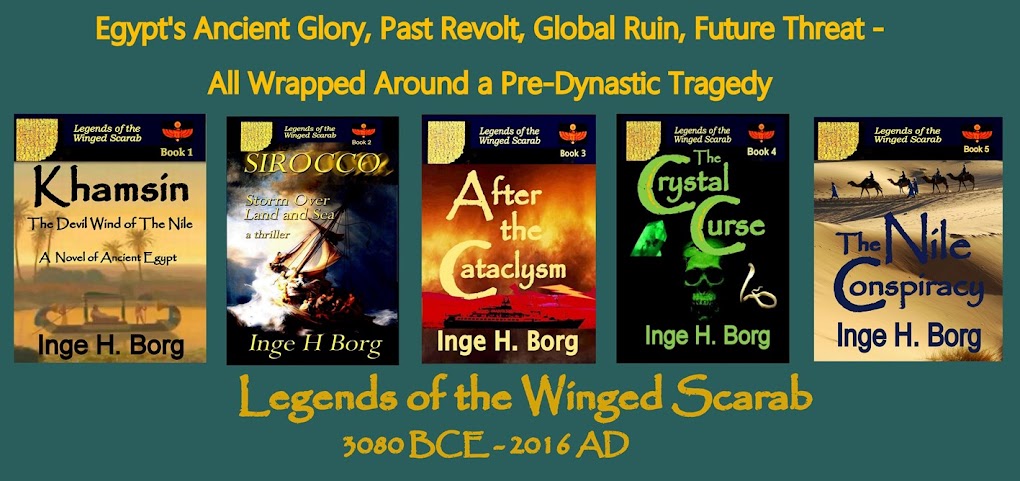
Actually, the second book in the “Legends of the Winged Scarab” series, Sirocco, Storm over Land and Sea, is a present-day thriller. It does have tie-ins to archaeological treasures from Khamsin, as will the planned Books Three and Four—each will play out during in very different places and times.
I also wrote a non-fiction book about my days as a shelter volunteer—and “the darn cat” that got the better of me.
My WIP, Mountain Shadows, might fit into a new category even though I did not know that’s what I was writing until I saw a Goodreads group that wants to breathe life into Boomer Lit.

Historical Fiction—Too boring, scholarly, irrelevant?
The emphasis here is on fiction. While I don’t write steamy, explicit stuff, there is plenty of action, innuendo and human deviousness in Khamsin. People then as now have their strengths and weaknesses, their foibles, ambitions and desires. It just plays out at a different time, in a different place. We, in our flawed humanity, have not changed for the better—nor will we do so any time soon.

How difficult was it to draw the balance between research and invention/ imagination?
There must be balance. The tendency “to show” what one knows is always there. To keep it from coming through as condescending, or even boring, surroundings, customs, etc. need to be woven into the action unobtrusively. If the reader feels he is there, even if he learns something new, you succeeded. There are plenty of knowledgeable readers—so you had better be accurate.
Particularly for Egypt, debates are being waged regarding the use of current names for cities and deities versus the Greek labels bestowed upon a conquered land. I mostly opted for the old Egyptian names (with an extensive glossary), but kept a couple of familiar gods.

Tell us briefly about all of your books.
Sirocco, Storm over Land and Sea is Book 2 of the “Legends of the Winged Scarab.” It is a present-day thriller with tie-ins to Khamsin, but stands alone in its action.
By the way, I was counseled against using a stolen Rembrandt painting as my cover—but I thought the public domain image portrayed ‘the perfect storm’ and I wove it into my story. Recently, the FBI issued a poster asking the public for help in the recovery of this work of art—something which I had already done in my foreword the prior year (there is a $5 million reward).
Edward, Con Extraordinaire, is a collection of short stories of a charmer’s San Diego escapades; it does have tie-ins to Sirocco, in which Edward turns out to be less gallant.
Pasha, From Animal Shelter to A Sheltered Life – non-fiction mentioned above.
Moments of the Heart, A Book of Poems and Short Prose – an early collection of—yes—poems and short stories.

What do you like best about writing? What’s your least favorite thing?
Although by upbringing, education and travel, I am socially adept and have always had to deal with people, I am basically a solitary creature. This writing life now suits me; I revel in it.
My least favorite things—and I am certain this is echoed by many fellow-authors—are editing and marketing. Trumpeting one’s name and titles onto indifferent ears, flogging unsuspecting readers with burps and blurbs, searching, weeding, hoping, giving away scores of books…it is painful to the artistic soul.
Of course, any day turns aglow when a thoughtful review is posted, a reaffirmation that one might have produced a book worthwhile reading. My hat is off to those dedicated readers who not only read for their own enjoyment but take the time and trouble to post reviews and let especially us “Indies” know how a book resonated with them.

Did you have any say in your cover art? What do you think of it? Tell us about the artist.
When my cover designer, fellow-author Diana Wilder—who also writes about Egyptian history—sent me the cover for Khamsin, she had inserted a small Khepri, a winged scarab, into her wind-swept landscape. ‘How cool,’ I thought. Uploading a corrected copy of the book, I slyly inserted a paragraph for this scarab to become the personal seal of the high priest, chiseled onto the Golden Tablets that serve as the tie-in to Sirocco.
For Sirocco, I again asked Diana to superimpose the small scarab onto that cover. Thanks to her inventive mind, I had my Leitmotif. The Legends of the Winged Scarab series was born (yes, there are two more volumes rattling around in my head).

What books have you read more than once or want to read again?
For sheer delight, I reread Peter Mayle’s Provence series every couple of years. They provide an escape for my earnest soul.

Did you find it difficult to research? How did you research?
Nowadays, the Internet is invaluable. If one takes its offerings with the proverbial grain of salt; and if one realizes what is public domain and what might not be. For instance, I was looking for a harbor on the island of Crete. And there was Loutro, tiny fishing village accessible only by water. Nothing could have been more perfect for my double-dealing yachties in Sirocco.

What would your characters say about the book?
Quite a few would shake their fists at me: “Did you have to kill me off!” (And my answer would be “Yes.”)

Who are your favourite characters and why?
I can’t explain why, from my myriad of characters in Khamsin, I often think of one who occupies barely half a page: Hanni, the Ostrich Egg Gatherer. Bent and battered, he lifts his rheumy eyes up at the High Priest in hopes of reprieve from his arduous tasks. His shriek, as he falls, still echoes.

Which author would you most like to invite to dinner, and what would you fix me? I mean, him. Or her.
Clive Cussler. (Surprised?) He not only writes about adventure, he has lived it. His thrills and technologically futuristic ideas are amazing (or they were before he started to draw on all those co-authors).
We’ll chat around the fireplace, over a Cognac. (I am a lousy cook).

How do you handle criticism of your work?
What criticism? Seriously, at first blush I huff and puff a bit. But then, I correct it, if it’s a glaring mistake, or change it if a better ‘whatever’ is suggested, as I did with the second edition of Sirocco where I was told to ‘for heaven’s sake, have Jonathan get laid already.’… “Oh, my!” I listened …

Tell us one weird thing, one nice thing, and one fact about where you live.
A) It’s a “dry” county—and I don’t mean it lacks for rain.
B) Lots of lakes, woods and hills. Very quiet and peaceful.
C) Tornado-prone area.

What three books have you read recently and would recommend?
Sadly, I am not reading as much as I should or want. But my “to-be-read” list is growing, not in the least from your own writings and recommendations in this blog. High on my list are books by Diana Wilder, James Hockey, and Tui Allen’s "Ripple," a dolphin’s tale. Last but not least, Christoph, I have just added your own writings.

If you could live anywhere in the world, where would it be?
On Kauai, the least crowded of the Hawaian islands.

If you could take a trip anywhere in the world, where would you go? (Don’t worry about the money. Your publisher is paying.)
Oh well, if it’s all paid for, then I would like to take a cruise up the Nile and visit all the sites in Upper Egypt, led by Dr. Zahi Hawass (but only if he is in a benign mood and wears his trade-mark Fedora).

What are you working on now?
A contemporary novel called Mountain Shadows, slated for publication in May (the main character is one of Edward’s former victims). There is also a time-constraint, only noticeable for those who read Sirocco and paid attention to the epilogue.
What else would you like us to know about yourself and your books?
I write what I write with enthusiasm; I care about what I write; I like what I write with the hope that my readers might like it too.

Read the complete interview at:

* * *
Christoph Fischer is an Independent widely-traveled writer from Germany, based in the UK.
His first book “The Luck of the Weissensteiners” is a historical novel set in 1930s and 1940s Slovakia and was published in November 2012.


And he just published “Sebastian,” another historical novel, set in Vienna in the 1910s.

Read more about Christoph on http://www.christophfischerbooks.com/

Christoph Fischer is also a reviewer of independent books and his recommendation pages on his blog feature interviews and reviews of the books that have most captured his attention and appreciation by genre.

Monday, April 22, 2013

Clouds of the Heart--Coming in May

Thanks to interesting and helpful feedback from other authors, I CHANGED my original title from Mountain Meadows to:
CLOUDS OF THE HEART

I also listened to their reactions about several draft covers,

and changed to this one:


As with several of my novels, there is a connection to Edward, Con Extraordinaire, and through Edward, also to SIROCCO, Storm over Land and Sea. I think it is like running into old acquantances on a street; of course, there might be some one would rather avoid.
Visually, this novella connects to Moments of the Heart --though there are no poems in
CLOUDS OF THE HEART, A Novella.

* * *
Description

     Attractive and successful, Monika Lenz has had it. With the city. With her job. With men. A year in the mountains, alone in a cabin, should bring the forty-five-year old back on track.
     There is beauty, and peace, and quiet. But there are also the shadows from dark clouds. Foreboding and relentless, they grasp at her and lure her soul deeper into its recesses.
    Can the elusive Jack MacGreedy pull her back from the abyss she has created in her mind, and in her heart?
* * *


Here are two old versions after the title had changed from Mountain Meadows to Mountain Shadows (sometimes, it takes a few tries):

This cover was my personal favorite. Mainly because the cover depicts the Edelgriess Peak in the Dachstein region, second highest in the Austrian Alps (2,995m—9,826ft). This typical way-station on a maintain trail was photographed by my father in the 1950s. Back then, people climbed these mountains on foot, often taking a whole week to hike from peak to peak. Now, everyone can enjoy breathtaking panoramas comfortably from gondolas and ski lifts.

I was advised that--commercially at least--it might be too esoteric.
 
Then, I came up with this one--- too bland, I was told.

Sunday, April 14, 2013

A 5-Star Review for SIROCCO

This review of SIROCCO, Storm over Land and Sea, is from a self-proclaimed 'highly addicted' reader--who read and reviewed Book One of the "Legends of the Winged Scarab" series--KHAMSIN, The Devil Wind of The Nile--first, also giving it five stars.


Great Story April 7, 2013
By diebus
Format:Paperback
I read "Sirocco, Storm over Land and Sea" by Inge H. Borg as a follow up to "Khamsin", her histroical novel set 3080 B.C., since I read that there were some connections between the two books. Having thoroughly enjoyed the first book I was pleasantly surprised to find Borg change direction from one genre to the next.

Set in present day Egypt with its political unrest during the Arab Spring and beyond it tells the story of Archaeologists, Museums, art collectors and their procedures, rivalry and bureaucracy during an expedition to Cairo where ancient golden tablets are to be deciphered.

Borg describes with great detail procedures and technology used in modern Archaeology and I settled in to a great contemporary book about Egyptology where the people and times of the previous book now have become the object of historical study. Just then two of the artefacts are stolen and a hunt through Greece and the Mediterranean Sea ensues.

Thrown into this is also a love triangle and rivalry between several characters, all of which have different interests in the missing artefacts. Borg enriches the plot with themes such as ancient curses to give you one more example of the broad spectrum of what to expect from this novel and thriller.

I enjoyed this book even more than the first in the series and loved when the old turned up in the new. In that it helps to bring to live the first book again and to underline again the bringing to life of the past that good historical fiction can achieve. While we where living with the ancient Priest in the last book, now he is the author of an ancient scroll and a mysterious figure.
The ancient storm, Sirocco, a symbol of the 'blast from the past' and the force of nature, which blows everything over, is a brilliant title for a book that has many more layers than I would have expected.

Besides all of this, it has great suspense and intriguing characters. I am glad that I read Khamsin first to appreciate everything the author has put into this book, but for its story alone it does not need the predecessor. A great read.

----------------------------------------
Take a "Look Inside" here: http://www.amazon.com/dp/B008Y6GXZ8

Saturday, April 13, 2013

Y’all are Looking at My Fish. Right!

Not all sailing involves storms.


Sometimes you are lucky enough to catch a big fish;
and unlucky enough to have to clean it.


Sunday, April 7, 2013

Offshore Sailing


White Wings on an Ocean,
straining, a billowing team.
The sailor braces against his contrary wheel
raping the rudder as lines wail taut.
The storm flogs with malice.

White Wings on an Ocean
screamed into shreds that bandage the mast. 
A halyard flails, lifelines gone,
the dinghy torn off.
The sailor weeps for soft green meadows.


Excerpted from my
Moments of the Heart,
A Book of Poems and Short Prose
 

Saturday, April 6, 2013

Hugo, the Atlantic’s Misbegotten Child


Sailing has played a big part in my life. Warm days, anchoring in sequestered coves, sipping a cool drink—and being with the man you love. Idyllic, wonderful, and forever-lasting, you think. But it takes only one bad storm to wipe all that warm and fuzzy feeling from your now terrified soul forever.

The following is an excerpt from my short story/poetry volume
“Moments of the Heart.”


* * *
Sometimes, I did wonder where and how I would die. This night, it seemed, held the answer: Latitude 18-North, Longitude 63-West, my murderess not the Atlantic but her misbegotten child Hugo, screeching its dirge over our pristine cutter, ripping our topsides bare. We were sailing miles offshore, likely beyond the saving reach of the Coast Guard, should we get into trouble.
A dripping figure swathed in stiff foul-weather gear slithered down the companionway, bringing with it the deluge of a following sea, before we both were able to slam the wooden slats into their grooves, closing off the large opening.
“Pouch! Hand GPS! Water! Flares!” the dripping, bug-eyed monster screamed into my ear. Short, long, short, short. Dit-Da-Dit-Dit. L, for Love. It was also the signal of Point Loma’s Radio Beacon. If only we were still on that San Diego coast instead of being churned to death in the romanticized Caribbean.
“Move, Move, Move!” the yellow apparition shouted and shook the diving goggles from his head. Without them, his eye-lids would have been shredded by the wind. Richard’s usually curly hair had been screamed into salt-stiffened arrows. For the last five hours, my intrepid skipper had hand-stirred our lovely double-ender across liquid mountains foaming their insolence at us, while I had lain strapped in a bunk mid-ships below, waiting for it to end. Wham! The boat’s death-shudder ripped away another strand of my badly frayed nerves. At least the lights were still on; a dark cabin would bring me to the brink of insanity, I was certain.
“Get the pouch!” Richard’s shout almost burst my eardrum.
Suddenly, it seemed that the noisy freight-train had pushed past us, leaving behind a sudden eerie calm. At least, we were still afloat. Oily water sloshed over my ankles and I shivered with cold. Other than that, I could not move. The Pouch? Where was it? We had trained for most emergencies but for the life of me I could not recall where that pouch had been stowed. It held our boat papers, passports, money. My teeth hurt from their uncontrolled chattering. There was a searing pain in my right temple. I watched Richard dig for something under the splintered chart table. The stove had wedged itself on top of it, its oven door hanging open like a village idiot’s uncomprehending mouth.
Richard turned back toward me. “Christ!” he said and laid his gloved hand against my face. When he pulled it away, the soggy leather dripped red. “Did the stove hit you?”
“I don’t remember.” I began to dry-heave.
“Hang in there, baby,” he said softly. “We have to pull our stuff together as long as the wind has calmed down. Can you help me?”
Help him? How? I couldn’t even move. I wanted to lay my head on his chest and cry my heart out; for me, for him, for our surely doomed Artemesia, our Nevada Tumbleweed, that had helped us forget our desert origins and carried us over thousands of miles of benevolent seas; until this awful night.
“Are we a-b-b-b-abandoning?” My teeth still chattered violently.
“Not yet. We’ll wait,” the lover I had followed into his dream said gently while hurriedly stuffing things into plastic bags.
“Wait? Oh, is the Coast Guard on its way then?” Suddenly, I was calm. Like a block of ice. I figured that was good. However, I still could not move which, I knew, was not.  Richard shook his head.
“We’ll wait for what?” I whispered again.
He was searching for something at the bulkhead where two large empty clamps reached back toward him. It was the first time I saw panic on his face. The EPIRB was gone. It would be our only hope for a rescue team to locate us.
“We can’t launch the life-raft until after,” Richard said and pulled a foul-weather jacket over my head, careful not to scrape against my blood-encrusted temple.
“Until after what? The water is getting higher in here. Why not now? It’s so much calmer outside now.”
The man I knew to be such a capable sailor didn’t look at me. “The calm will last only for a little while, sweetie.” He smiled with lips that formed a crooked apology, as if this was his fault. “We don’t have much time. We are in the eye of the hurricane.”
All of a sudden, I felt myself propelled forward, groping for things as I moved through the cabin. Pouch! GPS! Water! Flares! Life vest! I grabbed the long flashlight from under the companionway stairs and repeated to myself: Dit-Dit-Dit - Da-Da-Da - Dit-Dit-Dit. Three Short, Three Long, Three Short. S.O.S.

* * *